
這是歷史版本頁面 — 看 Zenmap 最新版本
不會用Nmap指令?Zenmap把網路掃描變圖形介面
 Zenmap 5.50
資料更新 2011-01-29
閱讀約 5 分鐘
你剛接手公司網管,或只是想搞清楚家裡網路到底連了哪些裝置。你知道要掃描網路、檢查哪些電腦開了哪些連接埠,但打開命令提示字元輸入指令時,參數一堆根本記不住,輸出結果密密麻麻看不懂。你需要的是一個能幫你把這些事變簡單的工具,而不是再去背指令手冊。
一般人的做法是上網找指令教學,複製貼上然後祈禱結果正確。但Nmap指令參數組合太多,不同掃描類型要配不同參數,貼錯一個字母結果就完全不一樣。這類工具的切入點是:把複雜的指令包裝成圖形介面,用表單和按鈕取代打字,讓你能專注在「想掃什麼」而不是「指令怎麼寫」。
01Zenmap是什麼,跟Nmap有什麼關係?
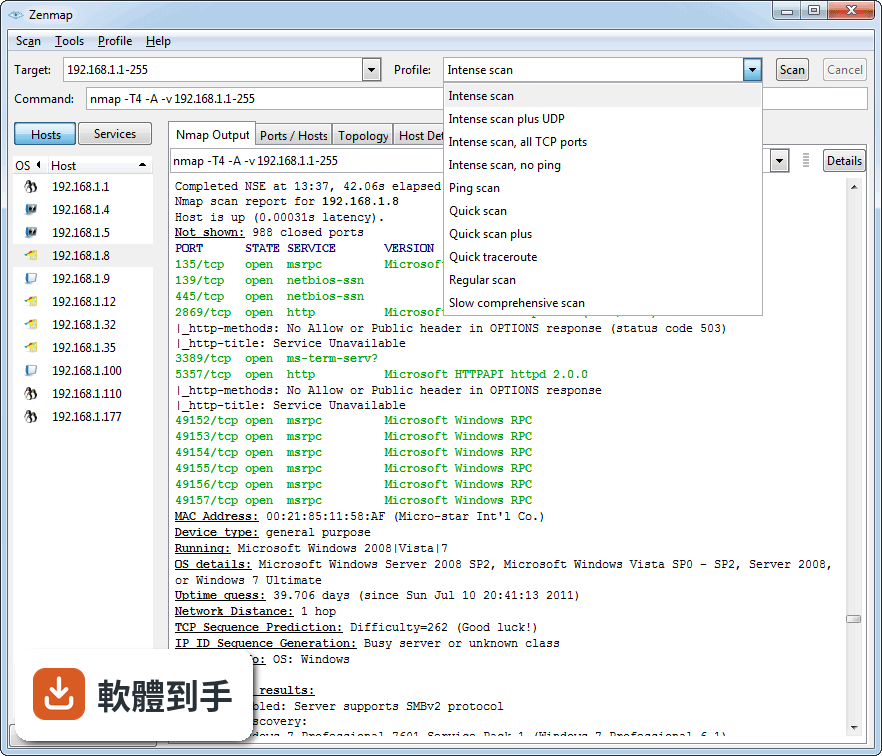
Zenmap是Nmap的官方圖形介面。Nmap本身是命令列工具,功能很強但必須用鍵盤輸入指令。Zenmap把這些指令包裝成視窗介面,你可以在欄位裡輸入目標IP或網域名稱,選好掃描類型,按一下按鈕就開始掃描。安裝Zenmap時會一起裝好Nmap,不需要分開處理。
02這套軟體能掃描哪些目標,只能掃一台電腦嗎?
可以掃描多個目標。除了單一IP位址,也支援輸入IP範圍或子網路,例如192.168.1.0/24這種寫法。也可以直接輸入主機名稱。掃描結果會列出所有找到的裝置、開啟的連接埠和服務,方便你一次掌握整個網路的狀況。
03掃描結果除了看連接埠,還能看到什麼資訊?
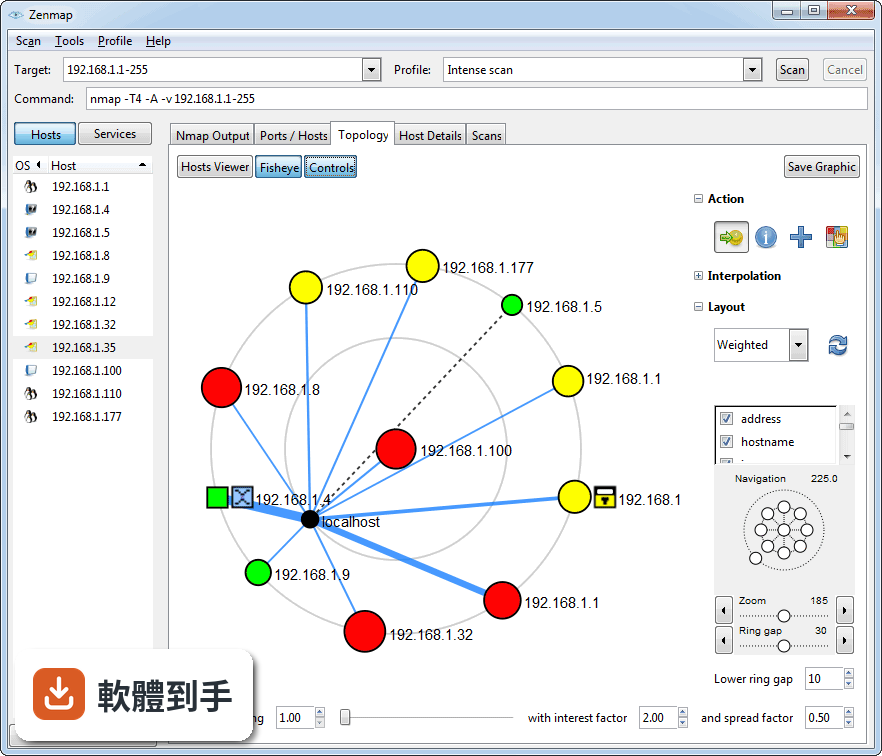
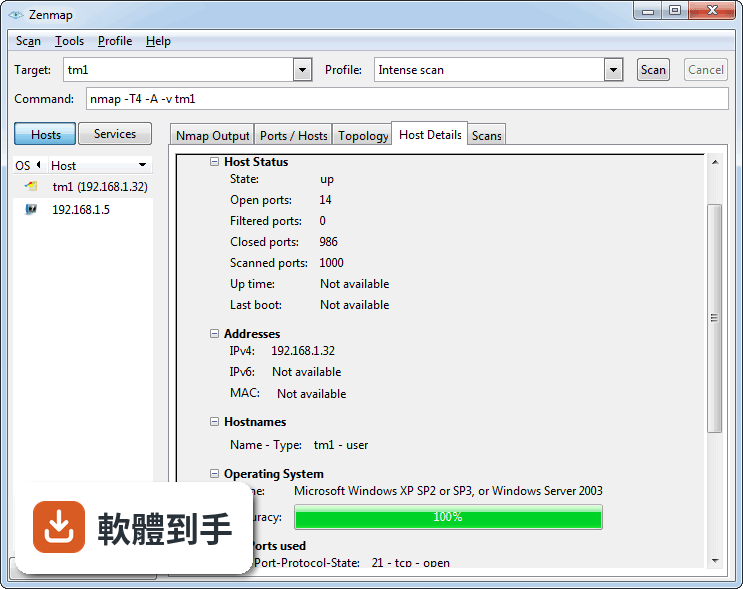
結果分幾個分頁顯示。除了連接埠和服務,還能看到主機詳細資料,包含作業系統偵測結果。另外有拓撲圖分頁,用圖形方式畫出網路裝置之間的連線關係。掃描紀錄會自動保存,之後可以回頭比對不同時間的掃描結果,看網路有沒有出現新的裝置或開啟新的連接埠。
04掃描結果可以存下來嗎?
可以。結果能匯出成XML或純文字格式,方便之後分析或記錄。如果你需要把掃描結果交給別人看,或自己留底比對,這個功能很實用。匯出後可以用其他工具開啟,或直接文字編輯器檢視。
05執行掃描需要管理員權限嗎?
要看掃描類型。基本的掃描可能不需要,但某些掃描像是作業系統偵測或SYN掃描,官方建議要有管理員權限才能完整執行。安裝時也需要管理員權限。如果你在一般使用者帳號下執行,可能會遇到部分功能無法使用的情況。
06我完全不懂網路指令,用這套軟體會卡關嗎?
它的設計就是讓不熟悉命令列的人也能用Nmap。介面有預設的掃描設定檔,例如「Intense scan」和「Quick scan」,直接選就能開始掃描。輸入目標位址、選好設定、按掃描,流程很直覺。不過掃描結果的解讀還是需要一些網路基礎知識,例如知道連接埠號碼代表的服務。
07這套軟體適合哪些人使用?
適合需要做網路安全稽核或管理的IT人員、滲透測試人員和系統管理員。如果你工作上需要定期檢查網路裝置、管理服務升級時程、監控主機或服務是否正常運作,這套軟體能幫你把Nmap的功能用圖形介面操作。對於想學習Nmap的人來說,也可以先從圖形介面理解掃描概念,再慢慢接觸指令。
08這套軟體還在持續更新嗎?
開發更新不算頻繁,屬於偶爾更新的狀態,但官方說明指出它仍然可以搭配新版本的Nmap正常運作。如果你擔心相容性問題,安裝時會一起安裝Nmap,兩者版本會搭配好。介面外觀比較舊,不是現代化的設計風格,但功能上沒有太大問題。
09介面只有英文,看不懂怎麼辦?
這套軟體的介面語系只有英文,沒有繁體中文。如果你英文閱讀有困難,操作上會比較吃力。不過主要欄位和按鈕的英文不算太複雜,配合線上教學或翻譯工具可以克服。如果完全無法接受英文介面,可以考慮其他有中文介面的掃描工具,但功能上可能沒有這麼完整。
10有沒有更簡單的替代軟體?
有。Angry IP Scanner、Advanced IP Scanner、SoftPerfect Network Scanner都是功能相近的掃描工具,介面更簡單,適合只想快速掃描IP和連接埠的使用者。但這些工具的進階功能不如Zenmap完整,例如拓撲圖、掃描紀錄比對、複雜的Nmap參數設定。如果你的需求只是偶爾掃一下網路,這些輕量工具可能更適合。
11非技術人員用這套軟體會遇到什麼困難?
官方說明提到,這套軟體對非技術使用者來說可能難以負擔。雖然圖形介面降低了指令門檻,但掃描結果的判讀、參數的選擇、權限的處理都需要網路基礎知識。如果你只是想知道家裡有哪些裝置連上Wi-Fi,用路由器管理介面或手機App可能更直接。這套軟體是給需要深入分析網路的人用的。
12這套軟體需要付費嗎?
不需要。它是開放原始碼軟體,可以免費下載使用。安裝程式會同時安裝Nmap和Zenmap,不需要額外購買授權。如果你之後想改用其他工具,也因為它是開放原始碼,社群有相關資源可以參考。
下載與官方連結
nmap-5.50-setup.exe · 18.99 MB · 連結指向軟體原廠
版本紀錄
- 2026-03-27 Zenmap 7.99 35.25 MB
- 2025-08-22 Zenmap 7.98 34.56 MB
- 2025-05-14 Zenmap 7.97 34.09 MB
再看 5 筆
- 2025-05-07 Zenmap 7.96 34.04 MB
- 2024-04-23 Zenmap 7.95 32.4 MB
- 2023-05-21 Zenmap 7.94
- 2022-09-02 Zenmap 7.93
- 2021-08-08 Zenmap 7.92
這一版改了什麼
What's new in this version:
- [Zenmap] Added a new script selection interface, allowing you to choose scripts and arguments from a list which includes descriptions of every available script. Just click the "Scripting" tab in the profile editor.
- [Nping] Added echo mode, a novel technique for discovering how your packets are changed (or dropped) in transit between the host they originated and a target machine. It can detect network address translation, packet filtering, routing anomalies, and more. You can try it out against our public Nping echo server using this command: nping --echo-client "public" echo.nmap.org'
- [NSE] Added an amazing 46 scripts, bringing the total to 177!
- broadcast-dns-service-discovery: Attempts to discover hosts' services using the DNS Service Discovery protocol.It sends a multicast DNS-SD query and collects all the responses.
- broadcast-dropbox-listener: Listens for the LAN sync information broadcasts that the Dropbox.com client broadcasts every 20 seconds, then prints all the discovered client IP addresses, port numbers, version numbers, display names, and more.
- broadcast-ms-sql-discover: Discovers Microsoft SQL servers in the same broadcast domain.
- broadcast-upnp-info: Attempts to extract system information from the UPnP service by sending a multicast query, then collecting, parsing, and displaying all responses.
- broadcast-wsdd-discover: Uses a multicast query to discover devices supporting the Web Services Dynamic Discovery (WS-Discovery) protocol. It also attempts to locate any published Windows Communication Framework (WCF) web services (.NET 4.0 or later).
- db2-discover: Attempts to discover DB2 servers on the network by querying open ibm-db2 UDP ports (normally port 523).
- dns-update.nse: Attempts to perform an unauthenticated dynamic DNS update.
- domcon-brute: Performs brute force password auditing against the Lotus Domino Console.
- domcon-cmd: Runs a console command on the Lotus Domino Console with the given authentication credentials (see also: domcon-brute).
- domino-enum-users: Attempts to discover valid IBM Lotus Domino users and download their ID files by exploiting the CVE-2006-5835 vulnerability.
- firewalk: Tries to discover firewall rules using an IP TTL expiration technique known as firewalking.
- ftp-proftpd-backdoor: Tests for the presence of the ProFTPD 1.3.3c backdoor reported as OSVDB-ID 69562. This script attempts to exploit the backdoor using the innocuous id command by default, but that can be changed with a script argument.
- giop-info: Queries a CORBA naming server for a list of objects.
- gopher-ls: Lists files and directories at the root of a gopher service. Remember those?
- hddtemp-info: Reads hard disk information (such as brand, model, and sometimes temperature) from a listening hddtemp service.
- hostmap: Tries to find hostnames that resolve to the target's IP address by querying the online database at http://www.bfk.de/bfk_dnslogger.html.
- http-brute: Performs brute force password auditing against http basic authentication.
- http-domino-enum-passwords: Attempts to enumerate the hashed Domino Internet Passwords that are (by default) accessible by all authenticated users. This script can also download any Domino ID Files attached to the Person document.
- http-form-brute: Performs brute force password auditing against http form-based authentication.
- http-vhosts: Searches for web virtual hostnames by making a large number of HEAD requests against http servers using common hostnames.
- informix-brute: Performs brute force password auditing against IBM Informix Dynamic Server.
- informix-query: Runs a query against IBM Informix Dynamic Server using the given authentication credentials (see also: informix-brute).
- informix-tables: Retrieves a list of tables and column definitions for each database on an Informix server.
- iscsi-brute: Performs brute force password auditing against iSCSI targets.
- iscsi-info: Collects and displays information from remote iSCSI targets.
- modbus-discover: Enumerates SCADA Modbus slave ids (sids) and collects their device information.
- nat-pmp-info: Queries a NAT-PMP service for its external address.
- netbus-auth-bypass: Checks if a NetBus server is vulnerable to an authentication bypass vulnerability which allows full access without knowing the password.
- netbus-brute: Performs brute force password auditing against the Netbus backdoor ("remote administration") service.
- netbus-info: Opens a connection to a NetBus server and extracts information about the host and the NetBus service itself.
- netbus-version: Extends version detection to detect NetBuster, a honeypot service that mimes NetBus.
- nrpe-enum: Queries Nagios Remote Plugin Executor (NRPE) daemons to obtain information such as load averages, process counts, logged in user information, etc.
- oracle-brute: Performs brute force password auditing against Oracle servers.
- oracle-enum-users: Attempts to enumerate valid Oracle user names against unpatched Oracle 11g servers (this bug was fixed in Oracle's October 2009 Critical Patch Update).
- path-mtu: Performs simple Path MTU Discovery to target hosts.
- resolveall: Resolves hostnames and adds every address (IPv4 or IPv6,depending on Nmap mode) to Nmap's target list. This differs from Nmap's normal host resolution process, which only scans the first address (A or AAAA record) returned for each host name.
- rmi-dumpregistry: Connects to a remote RMI registry and attempts to dump all of its objects.
- smb-flood: Exhausts a remote SMB server's connection limit by by opening as many connections as we can. Most implementations of SMB have a hard global limit of 11 connections for user accountsand 10 connections for anonymous. Once that limit is reached, further connections are denied. This script exploits that limit by taking up all the connections and holding them.
- ssh2-enum-algos: Reports the number of algorithms (for encryption,compression, etc.) that the target SSH2 server offers. If verbosity is set, the offered algorithms are each listed by type.
- stuxnet-detect: Detects whether a host is infected with the Stuxnet worm (http://en.wikipedia.org/wiki/Stuxnet).
- svn-brute: Performs brute force password auditing against Subversion source code control servers.
- targets-traceroute: Inserts traceroute hops into the Nmap scanning queue. It only functions if Nmap's --traceroute option is used and the newtargets script argument is given.
- vnc-brute: Performs brute force password auditing against VNC servers.
- vnc-info: Queries a VNC server for its protocol version and supported security types.
- wdb-version: Detects vulnerabilities and gathers information (such as version numbers and hardware support) from VxWorks Wind DeBug agents.
- wsdd-discover: Retrieves and displays information from devices supporting the Web Services Dynamic Discovery (WS-Discovery) protocol. It also attempts to locate any published Windows Communication Framework (WCF) web services (.NET 4.0 or later).
- [NSE] Added 12 new protocol libraries:
* dhcp.lua by Ron
* dnssd.lua (DNS Service Discovery)
* ftp.lua
* giop.lua (CORBA naming service)
* informix.lua (Informix database)
* iscsi.lua (iSCSI - IP based SCSI data transfer)
* nrpc.lua (Lotus Domino RPC)
* rmi.lua (Java Remote Method Invocation)
* tns.lua (Oracle)
* upnp.lua (UPnP support)
* vnc.lua (Virtual Network Computing)
* wsdd.lua (Web Service Dynamic Discovery)
- [NSE] Added a new brute library that provides a basic framework and logic for brute force password auditing scripts.
- [Zenmap] Greatly improved performance for large scans by benchmarking intensively and then recoding dozens of slow parts. Time taken to load our benchmark file (a scan of just over a million IPs belonging to Microsoft corporation, with 74,293 hosts up) was reduced from hours to less than two minutes. Memory consumption decreased dramatically as well.
- Performed a major OS detection integration run. The database has grown more than 14% to 2,982 fingerprints and many of the existing fingerprints were improved. Highlights include Linux 2.6.37, iPhone OS 4.2.1, Solaris 11, AmigaOS 3.1, GNU Hurd 0.3, and MINIX 2.0.4.
- Performed a huge version detection integration run. The number of signatures has grown by more than 11% to 7,355. More than a third of our signatures are for http, but we also detect 743 other service protocols, from abc, acap, access-remote-pc, and achat to zenworks, zeo, and zmodem.
- [NSE] Added the target NSE library which allows scripts to add newly discovered targets to Nmap's scanning queue. This allows Nmap to support a wide range of target acquisition techniques. Scripts which can now use this feature include dns-zone-transfer, hostmap, ms-sql-info, snmp-interfaces, targets-traceroute, and several more.
- [NSE] Nmap has two new NSE script scanning phases. The new pre-scan occurs before Nmap starts scanning. Some of the initial pre-scan scripts use techniques like broadcast DNS service discovery or DNS zone transfers to enumerate hosts which can optionally be treated astargets. The other phase (post scan) runs after all of Nmap's scanning is complete. We don't have any of these scripts yet, but they could compile scan statistics or present the results in a different way. One idea is a reverse index which provides a list of services discovered during a network scan, along with a list of IPs found to be running each service.
- [NSE] A new --script-help option describes all scripts matching a given specification. It accepts the same specification format as --script does. For example, try 'nmap --script-help "default or http-*"'.
- Dramatically improved nmap.xsl (used for converting Nmap XML output to HTML). In particular:
* Put verbose details behind expander buttons so you can see them if you want, but they don't distract from the main output. In particular, offline hosts and traceroute results are collapsed by default.
* Improved the color scheme to be less garish.
* Added support for the new NSE pre-scan and post-scan phases.
* Changed script output to use 'pre' tags to keep even lengthy output readable.
* Added a floating menu to the lower-right for toggling whether closed/filtered ports are shown or not (they are now hidden by default if Javascript is enabled) Many smaller improvements were made as well. You can find the new file at http://nmap.org/svn/docs/nmap.xsl, and here is an example scan processed through it:
- [NSE] Created a new "broadcast" script category for the broadcast-* scripts. These perform network discovery by broadcasting on the local network and listening for responses. Since they don't directly relate to targets specified on the command line, these are kept out of the default category (nor do they go in "discovery").
- Integrated cracked passwords from the Gawker.com compromise (http://seclists.org/nmap-dev/2010/q4/674) into Nmap's top-5000 password database. A team of Nmap developers lead by Brandon Enright has cracked 635,546 out of 748,081 password hashes so far (85%). Gawker doesn't exactly have the most sophisticated users on the Internet--their top passwords are "123456", "password", "12345678", "lifehack", "qwerty", "abc123", "12345", "monkey", "111111", "consumer", and "letmein".
- XML output now excludes output for down hosts when only doing host discovery, unless verbosity (-v) was requested. This is how it already worked for normal scans, but the ping-only case was overlooked.
- Updated the Windows build process to work with (and require) Visual C++ 2010 rather than 2008. If you want to build Zenmap too, you now need Python 2.7 (rather than 2.6) and GTK+ 2.22. See http://nmap.org/book/inst-windows.html#inst-win-source
- Merged port names in the nmap-services file with allocated names from the IANA (http://www.iana.org/assignments/port-numbers). We only added IANA names which were "unknown" in our file--we didn't deal with conflicting names.
- Enabled the ASLR and DEP security technologies for Nmap.exe, Ncat.exe and Nping.exe on Windows Vista and above. Visual C++ will set the /DYNAMICBASE and /NXCOMPAT flags in the PE header. Executables generated using py2exe or NSIS and third part binaries (OpenSSL, WinPcap) still don't support ASLR or DEP. Support for DEP on XP SP3, using SetProcessDEPPolicy(), could still be implemented.
- Investigated using the CPE (Common Platform Enumeration) standard for describing operating systems, devices, and service names for Nmap OS and service detection.
- [Zenmap] Improved the output viewer to show new output in constant time. Previously it would get slower and slower as the output grew longer, eventually making Zenmap appear to freeze with 100% CPU. Rob Nicholls and Ray Middleton helped with testing.
- The Linux RPM builds of Nmap and related tools (ncat, nping, etc.) now link to system libraries dynamically rather than statically. They still link statically to dependency libraries such as OpenSSL, Lua, LibPCRE, Libpcap, etc. We hope this will improve portability so the RPMs will work on distributions with older software (like RHEL, Debian stable) as well as more bleeding edge ones like Fedora.
- [NSE] Added the ability to send and receive on unconnected sockets.This can be used, for example, to receive UDP broadcasts without having to use Libpcap. A number of scripts have been changed so that they can work as prerule scripts to discover services by UDP broadcasting, and optionally add the discovered targets to the
* scanning queue:
> ms-sql-info
> upnp-info
> dns-service-discovery
- The nmap.new_socket function can now optionally take a default protocol and address family, which will be used if the socket is not connected. There is a new nmap.sendto function to be used with unconnected UDP sockets.
- [Nping] Substantially improved the Nping man page.
- Documented the licenses of the third-party software used by Nmap and it's sibling tools:
- [NSE] Improved the SMB scripts so that they can run in parallel rather than using a mutex to force serialization. This quadrupled the SMB scan speed in one large scale test.
- Added a simple Nmap NSE script template to make writing new scripts
- [Zenmap] Made the topology node radiuses grow logarithmically instead of linearly, so that hosts with thousands of open ports don't overwhelm the diagram. Also only open ports (notopen|filtered) are considered when calculating node sizes. Henri Doreau found and fixed a bug in the implementation.
- [NSE] Added the get_script_args NSE function for parsing script arguments in a clean and standardized way
- Increased the initial RTT timeout for ARP scans from 100 ms to 200 ms. Some wireless and VPN links were taking around 300 ms to respond. The default of one retransmission gives them 400 ms to be detected.
- Added new version detection probes and signatures from Patrik for:
* Lotus Domino Console running on tcp/2050 (shows OS and hostname)
* IBM Informix Dynamic Server running native protocol (shows hostname, and file path)
* Database servers running the DRDA protocol
* IBM Websphere MQ (shows name of queue-manager and channel)
- Fix Nmap compilation on OpenSolaris
- [NSE] The http library's request functions now accept an additional "auth" table within the option table, which causes Basic authentication credentials to be sent.
- Improved IPv6 host output in that we now remember and report the forward DNS name (given by the user) and any non-scanned addresses(usually because of round robin DNS).We already did this forIPv4.
- [Zenmap] Upgraded to the newer gtk.Tooltip API to avoid deprecation messages about gtk.Tooltip.
- [NSE] Made dns-zone-transfer script able to add new discovered DNS records to the Nmap scanning queue.
- [NSE] Enhance ssl-cert to also report the type and bit size of SSL certificate public keys
- [Ncat] Make --exec and --idle-timeout work when connecting with--proxy.
- [Nping] Fixed a bug which caused Nping to fail when targeting broadcast addresses
- [Nping] Nping now limits concurrent open file descriptors properly based on the resources available on the host
- [NSE] Improved ssh2's kex_init() parameters: all of the algorithm and language lists can be set using new keys in the "options" table argument. These all default to the same value used before. Also, the required "cookie" argument is now replaced by an optional "cookie"key in the "options" table, defaulting to random bytes as suggested by the RFC.
- Ncat now logs Nsock debug output to stderr instead of stdout forconsistency with its other debug messages.
- [NSE] Added a new function, shortport.http, for HTTP script portrules and changed 14 scripts to use it.
- Updated to the latest config.guess and config.sub. Thanks to Ty Miller for a reminder.
- [NSE] Added prerule support to snmp-interfaces and the ability to add the remote host's interface addresses to the scanning queue. The new script arguments used for this functionality are "host" (required) and "port" (optional).
- Fixed some inconsistencies in nmap-os-db and a small memory leak that would happen where there was more than one round of OS detection. These were reported by Xavier Sudre from netVigilance.
- [NSE] Fixed a bug with worker threads calling the wrong destructors. Fixing this allows better parallelism in http-brute.nse. The problem was reported by Patrik Karlsson.
- Upgraded the OpenSSL binaries shipped in our Windows installer to version 1.0.0a.
- [NSE] Added prerule support to the dns-zone-transfer script,allowing it to run early to discover IPs from DNS records and optionally add those IPs to Nmap's target queue. You must specify the DNS server and domain name to use with script arguments.
- Changed the name of libdnet's sctp_chunkhdr to avoid a conflict witha struct of the same name in . This caused a compilation error when Nmap was compiled with an OpenSSL that had SCTP support.
- [NSE] Implemented a big cleanup of the Nmap NSE Nsock library binding code.
- Added a bunch of Apple and Netatalk AFP service detection signatures. These often provide extra details such as whether the target is a MacBook Pro, Air, Mac Mini, iMac, etc.
- [NSE] Host tables now have a host.traceroute member available when --traceroute is used. This array contains the IP address, reverse DNS name, and RTT for each traceroute hop.
- [NSE] Made the ftp-anon script return a directory listing when anonymous login is allowed.
- [NSE] Added the nmap.resolve() function. It takes a host name and optionally an address family (such as "inet") and returns a table containing all of its matching addresses. If no address family is specified, all addresses for the name are returned.
- [NSE] Added the nmap.address_family() function which returns the address family Nmap is using as a string (e.g., "inet6" is returned if Nmap is called with the -6 option).
- [NSE] Scripts can now access the MTU of the host.interface device using host.interface_mtu.
- Restrict the default Windows DLL search path by removing the current directory. This adds extra protection against DLL hijacking attacks, especially if we were to add file type associations to Nmap in the future. We implement this with the SetDllDirectory function when available (Windows XP SP1 and later). Otherwise, we call SetCurrentDirectory with the directory containing the executable.
- Nmap now prints the MTU for interfaces in --iflist output.
- [NSE] Removed references to the MD2 algorithm, which OpenSSL 1.x.x no longer supports.
- [Ncat,NSE] Server Name Indication (SNI) is now supported by Ncat and Nmap NSE, allowing them to connect to servers which run multiple SSL websites on one IP address. To enable this for NSE, the nmap.connect function has been changed to accept host and port tables (like those provided to the action function) in place of a string and a number.
- [NSE] Renamed db2-info and db2-brute scripts to drda-*. Added support other DRDA based databases such as IBM Informix Dynamic Server and Apache Derby.
- [Nsock] Added a new function, nsi_set_hostname, to set the intended hostname of the target. This allows the use of Server Name Indication in SSL connections.
- [NSE] Limits the number of ports that qscan will scan (now up to 8 open ports and up to 1 closed port by default). These limits can be controlled with the qscan.numopen and qscan.numclosed script arguments.
- [NSE] Made sslv2.nse give special output when SSLv2 is supported, but no SSLv2 ciphers are offered. This happened with a specific Sendmail configuration.
- [NSE] Added a "times" table to the host table passed to scripts. This table contains Nmap's timing data (srtt, the smoothed round trip time; rttvar, the rtt variance; and timeout), all represented as floating-point seconds. The ipidseq and qscan scripts were updated to utilize the host's timeout value rather than using aconservative guess of 3 seconds for read timeouts.
- Fixed the fragmentation options (-f in Nmap, --mtu in Nmap & Nping),which were improperly sending whole packets in version 5.35DC1.
- [NSE] When receiving raw packets from Pcap, the packet capture time is now available to scripts as an additional return value from pcap_receive(). It is returned as the floating point number of seconds since the epoch. Also added the nmap.clock() function whichreturns the current time (and convenience functions clock_ms() and clock_us()). Qscan.nse was updated to use this more accurate timing data.
- [Ncat,Nsock] Fixed some minor bugs discovered using the Smatch source code analyzer (http://smatch.sourceforge.net/).
- [Zenmap] Fixed a crash that would happen after opening the search window, entering a relative date criterion such as "after:-7", and then clicking the "Expressions" button. The error message was AttributeError: 'tuple' object has no attribute 'strftime'
- Added a new packet payload--a NAT-PMP external address request for port 5351/udp. Payloads help us elicit responses from listening UDP services to better distinguish them from filtered ports. This payload goes well with our new nat-pmp-info script.
- Updated IANA IP address space assignment list for random IP (-iR) generation.
- [Ncat] Ncat now uses case-insensitive string comparison when checking authentication schemes and parameters. Florian Roth found a server offering "BASIC" instead of "Basic", and the HTTP RFC requires case-insensitive comparisons in most places.
- [NSE] There is now a limit of 1,000 concurrent running scripts,instituted to keep memory under control when there are many open ports. Nathan reported 3 GB of memory use (with an out-of-memory NSE crash) for one host with tens of thousands of open ports. This limit can be controlled with the variable CONCURRENCY_LIMIT in nse_main.lua.
- The command line in XML output (/nmaprun/@args attribute) now does quoting of whitespace using double quotes and backslashes. This allows recovering the original command line array even when arguments contain whitespace.
- Added a service detection probe for master servers of Quake 3 and related games.
- [Zenmap] Updated French translation.
- [Zenmap] Fixed an crash when printing a scan that had no output(like a scan made by command-line Nmap). Henri Doreau noticed the error.